PM Modi Links Peace, Security and Development in Powerful SCO Address on Terrorism
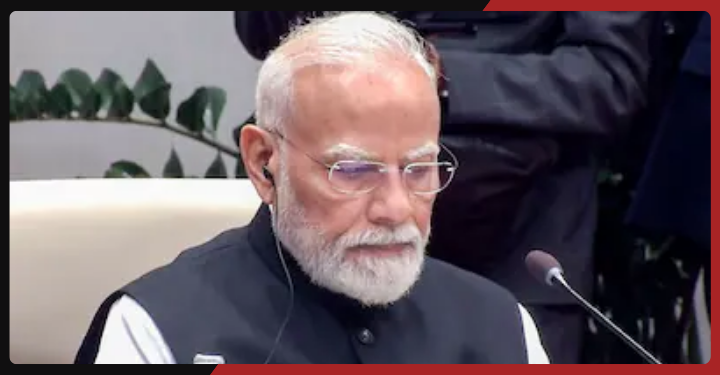
Prime Minister Narendra Modi placed terrorism and regional security at the centre of his address at the Shanghai Cooperation Organisation Summit, making a strong case for united international action.
The Prime Minister warned against double standards in dealing with terrorism and called for the complete dismantling of the networks that support extremist activities.
Pakistan Prime Minister Shehbaz Sharif was also present at the summit, adding greater diplomatic attention to PM Modi’s remarks.
India’s Prime Minister stressed that terrorism remains a serious challenge to peace and stability.
He urged SCO countries to work collectively against terror financing, recruitment, radicalisation and safe havens.
PM Modi’s message went beyond traditional security concerns.
He connected the issue of terrorism with the larger goals of economic development and regional prosperity.
According to this approach, countries cannot fully achieve their economic potential when they are facing instability and violence.
Terrorism can discourage investment, disrupt trade routes and create uncertainty.
For regions seeking greater connectivity and economic cooperation, security becomes an essential foundation.
The SCO has become an important forum for discussions involving both security and development.
Its member nations represent a significant part of Asia and Eurasia.
PM Modi’s speech highlighted the need to address common challenges through collective cooperation.
The Prime Minister’s strongest message concerned the need to eliminate double standards.
India has consistently maintained that terrorism cannot be judged differently based on who carries it out or where it occurs.
Selective approaches can create loopholes that extremist organisations may exploit.
PM Modi’s call was therefore for a universal and consistent policy.
The fight against terrorism, according to India’s position, must include action against every part of the system supporting it.
Financial networks are crucial because terrorist organisations require resources.
Recruitment systems allow extremist groups to grow.
Radicalisation spreads violent ideology and creates new security threats.
Safe havens provide places where groups can organise and operate.
Addressing only one of these areas may not be enough.
PM Modi’s call for dismantling the complete ecosystem reflected India’s belief that counterterrorism must be comprehensive.
The presence of Pakistan Prime Minister Shehbaz Sharif ensured that the remarks received additional international attention.
Relations between India and Pakistan have remained sensitive, particularly over security concerns.
However, PM Modi’s speech framed terrorism as a challenge facing the entire international community.
This broader approach allowed India to present its position before leaders from across the SCO region.
The Prime Minister also spoke about the importance of dialogue and diplomacy in resolving conflicts, stressing that lasting solutions cannot simply come from the battlefield. His comments came against a backdrop of wider international conflicts and regional instability.
This combination of messages reflected India’s larger vision for international relations: stronger security cooperation, peaceful conflict resolution and greater economic development.
PM Modi’s SCO address therefore carried significance beyond a single issue.
It presented security and development as interconnected priorities.
Without peace, development becomes difficult.
Without international cooperation, terrorism becomes harder to control.
And without a consistent approach, the global fight against extremist violence can lose effectiveness.
The Prime Minister’s message was ultimately a call for responsibility.
Every country must recognise that terrorism is not someone else’s problem.
It can threaten societies, economies and international stability.
PM Modi’s strong words at the SCO Summit reinforced India’s demand for unity and decisive action.
The fight against terrorism, India believes, must be based on one clear principle: there can be no compromise and no double standards when the security of humanity is at stake.